
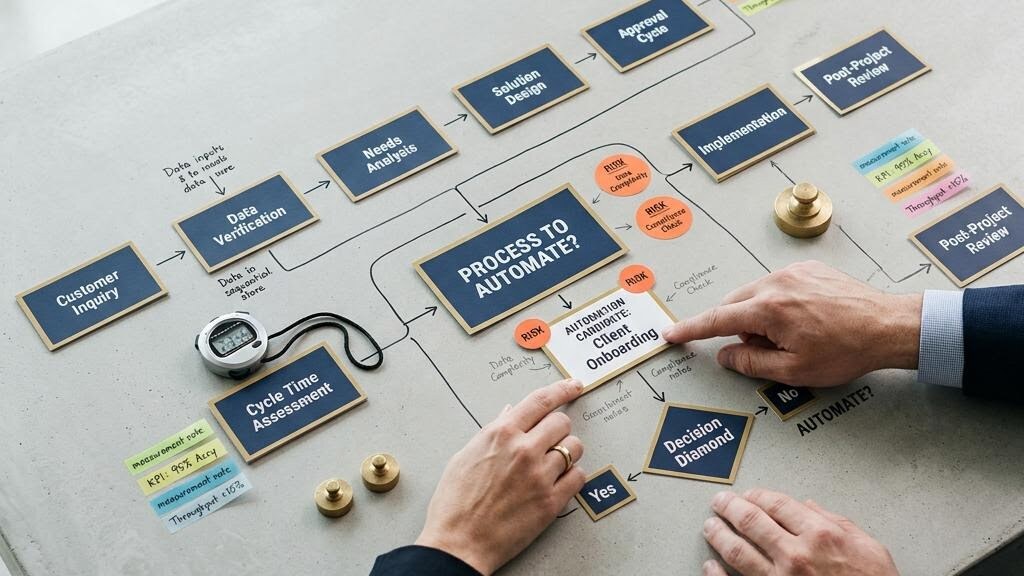
A workflow is ready for automation when it is frequent, understood, measurable, and stable enough to document. The strongest first candidates have clear inputs, repeatable rules, visible bottlenecks, and staff who can test the redesigned process.
Five Signs a Workflow Is Ready
1. The work happens repeatedly
High-frequency tasks create enough volume to justify redesign and produce useful baseline data.
2. Staff can explain the current process
If every employee describes a different process, standardization should come before automation.
3. Inputs and outputs are identifiable
Forms, emails, documents, approvals, records, and notifications should have clear owners and destinations.
4. Success can be measured
Useful measures include cycle time, backlog, error rate, rework, staff effort, response time, and customer experience.
5. Exceptions are known
Automation must account for missing information, urgent cases, accessibility needs, and situations that require judgment.
A Practical Readiness Scorecard
Ask workflow owners to rate volume, stability, data availability, risk, expected value, integration complexity, and staff readiness. A high-value workflow with uncontrolled sensitive data may not be the right first project. A modest workflow with clear rules may produce a better pilot.
What to Do Before Building
Map the process as it actually operates. Remove duplicate approvals, clarify ownership, define human checkpoints, and establish a baseline. Then prototype with a small user group and production-appropriate data controls.
Frequently Asked Questions
What should not be automated first?
Avoid poorly understood processes, highly consequential decisions, unstable policies, and workflows without accountable owners or usable baseline data.
Is AI required for automation?
No. Rules-based workflow automation is often the best solution. AI is useful when the work involves language, documents, classification, or drafting.
How long should a pilot run?
The pilot should be long enough to capture normal volume and exceptions, with clear checkpoints for measurement, feedback, revision, and a decision to scale or stop.
Ready to modernize your operations?
Book a discovery call to discuss practical implementation.