
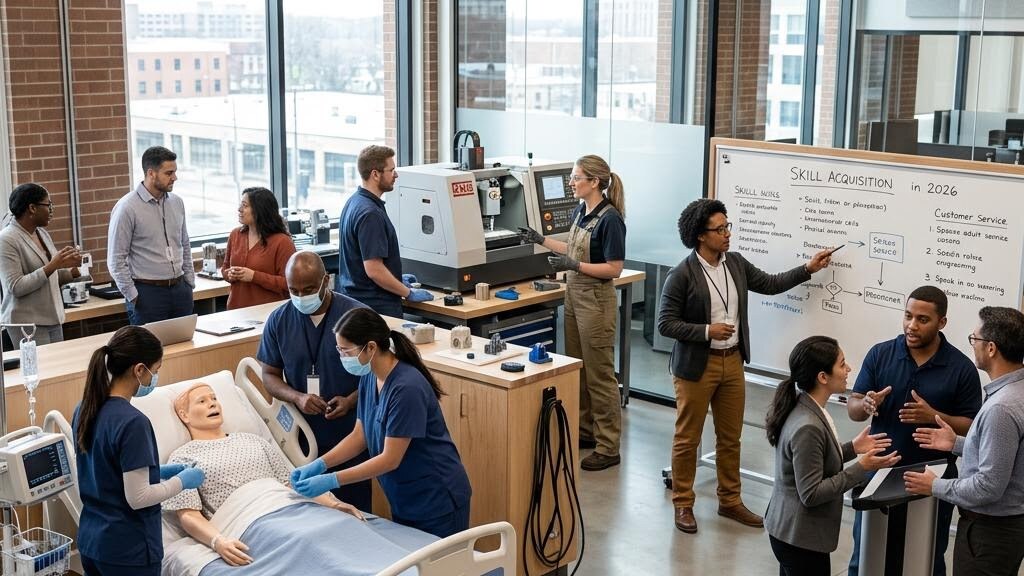
Workforce development in the age of AI should prepare people to work with new tools, adapt as tasks change, and demonstrate durable human skills. Programs should connect training to real employer workflows while ensuring access for participants with different digital backgrounds and abilities.
Jobs Are Changing at the Task Level
AI rarely changes every part of a job at once. It changes specific tasks: drafting, research, scheduling, documentation, analysis, and customer communication. Workforce programs can respond by mapping occupations into tasks and identifying where technology changes the required skills.
Four Priorities for Workforce Programs
Build practical AI literacy
Participants need to understand what AI can do, where it fails, how to protect information, and how to verify outputs.
Teach through real workflows
Practice should reflect the tools, documents, and decisions people will encounter at work. Generic demonstrations do not establish job readiness.
Preserve equitable access
Programs should account for device access, language, disability, digital confidence, and the cost of commercial tools.
Align with employers continuously
Advisory groups and hiring partners should validate which tasks are changing and what evidence demonstrates readiness.
What Employers Can Contribute
Employers can share anonymized workflows, define skills-based requirements, offer work-based learning, and help programs evaluate whether training transfers to the job. They should also explain how their organizations govern AI and where human accountability remains.
Frequently Asked Questions
What AI skills do most workers need?
Most workers need safe-use fundamentals, effective prompting, source verification, workflow judgment, and the ability to recognize when escalation is required.
Will technical training alone be enough?
No. Communication, critical thinking, service orientation, adaptability, and domain knowledge become more important when AI handles routine production tasks.
How should programs measure success?
Measure skill demonstration, completion, placement, retention, wage progression, employer satisfaction, accessibility, and the ability to apply learning in real work.
Ready to modernize your operations?
Book a discovery call to discuss practical implementation.